- Apple Podcasts
- Spotify
- SoundCloud
- Google Podcasts
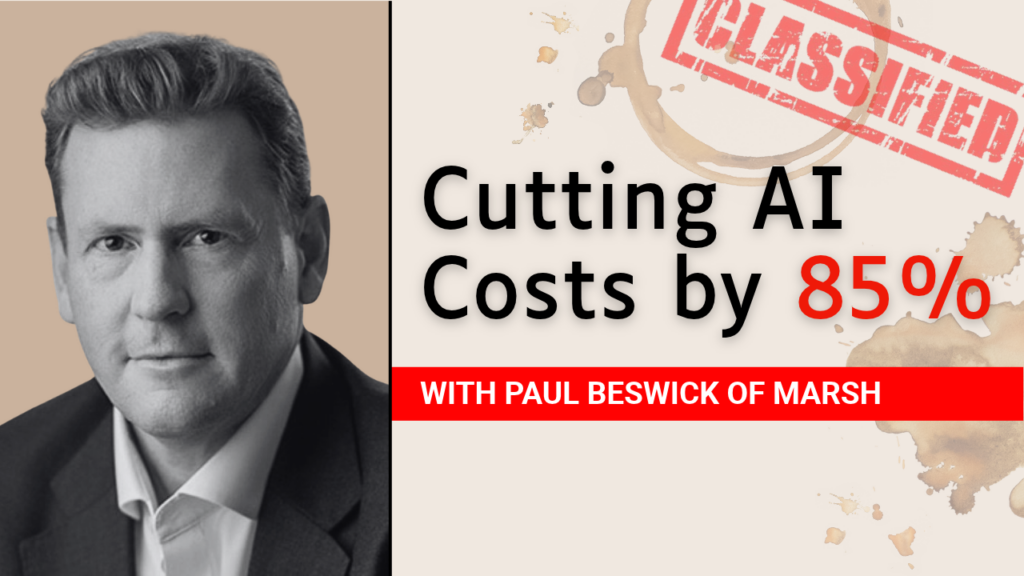
No Token Limits: Cutting AI Costs with Paul Beswick of Marsh
Marsh’s Paul Beswick on keeping AI free of token limits, and how his team cut costs 85% in two weeks so people keep experimenting.
Listen Now On
ABOUT THE GUESTS
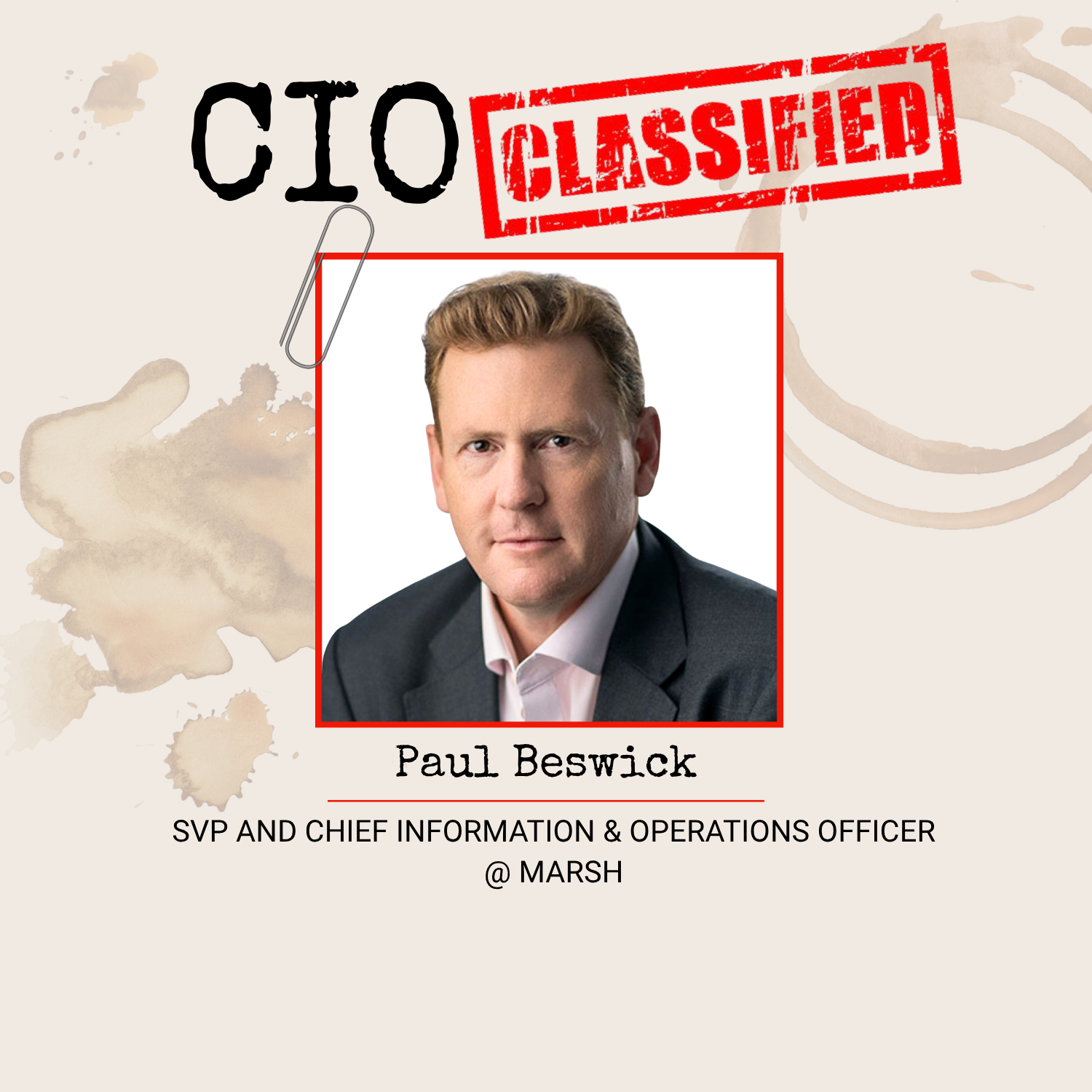
Paul Beswick is Senior Vice President and Chief Information and Operations Officer of Marsh. He oversees Business and Client Services, which brings together the Operations, Technology and Innovation and Data teams in support of the firm’s global businesses. Prior to his current role, Paul variously served as Chief Information Officer, Deputy CIO, and Global Head of Oliver Wyman Labs and the Digital Practice at Oliver Wyman.
Paul Beswick, Senior Vice President and Chief Information & Operations Officer at Marsh, won’t put token limits on his people, so when AI costs spiked, his team cut them 85% in two weeks. The spike came from Lenwork, Marsh’s homegrown answer to Claude Cowork, which burned far more tokens than the chat tool before it. Because Marsh builds its own harnesses and rents the intelligence, Paul had levers a commercial license would never give him, and he now runs at well under 10% of what equivalent tools would cost.
Paul also makes the case that code is no longer the rate-limiting step in enterprise delivery: the organizational incentives that push every need into a big, risky program are. He explains the platform his team built years before generative AI so a project could, in theory, go from idea on Monday to production on Friday, how Lenwork reached half the firm with no official launch, and why he assumes he’ll regret nearly every technology decision within five years.
Listen or subscribe wherever you get your podcasts. Watch on YouTube: https://www.youtube.com/@CIOClassifiedPodcast
3 Takeaways:
- AI cost is an engineering problem for the CIO to solve, and rationing tokens kills the experimentation that makes AI valuable.
- Once code is cheap to write, organizational structure and budgeting incentives become the real limit on delivery speed.
- Assume you’ll regret every technology decision within six months to five years, and build your exit in from day one.
⏱️ Chapters:
(01:14) Paul Beswick’s Path to Global CIO
(03:21) Why Enterprise Software Delivery Gets Stuck
(07:06) Engineering for Monday-to-Friday Delivery
(11:44) How to Keep Context With AI Coding Agents
(15:19) Building an Engineering Culture at Enterprise Scale
(18:34) Building LenAI: Marsh McLennan’s GenAI Suite
(22:28) How LenAI Spread Without a Formal Launch
(26:08) How They Cut LLM Token Costs by 85%
(29:22) Why a Model-Agnostic AI Strategy Wins
(31:50) Project Apex and What New AI Models Unlock
About Paul:
Paul Beswick is Senior Vice President and Chief Information and Operations Officer of Marsh. He oversees Business and Client Services, which brings together our Operations, Technology and Innovation and Data teams in support of the firm’s global businesses. Prior to his current role, Paul variously served as Chief Information Officer, Deputy CIO, and Global Head of Oliver Wyman Labs and the Digital Practice at Oliver Wyman. With more than two decades at Oliver Wyman, he worked across various sectors, including financial services, retail, transportation, telecoms, and consumer goods. Paul holds an MA (first class) in chemical engineering from Cambridge University.
💡 Guest Highlights:
“I don’t want token limits. I don’t want to discourage them from experimenting, from trying stuff. I want to treat that as an engineering problem. It’s on me to make it cheap enough that they can consume in an unlimited way.”
“I have a general philosophy that almost every technology decision that you make, you’re gonna regret somewhere between six months and five years from now. And so I worry a lot about how I get out of them.”
“Security or agility. Well, it’s a trade-off until you make it not a trade-off anymore, and that’s an engineering problem.”
🔗 Get Connected:
-
- Yousuf Kahn: https://www.linkedin.com/in/yousufakhan/
- Paul Beswick: https://www.linkedin.com/in/paul-beswick/?isSelfProfile=false
🚀 Our Sponsor:
Want to accelerate software development by 500%? Meet Blitzy, the only autonomous code generation platform with infinite code context, purpose-built for large, complex enterprise-scale codebases.
While other AI coding tools provide snippets of code and struggle with context, Blitzy ingests millions of lines of code and orchestrates thousands of agents that reason for hours to map every line-level dependency.
With a complete contextual understanding of your codebase, Blitzy is ready to be deployed at the beginning of every sprint. Blitzy handles the heavy lifting, delivering over 80% of the work autonomously. The platform plans, builds, and validates premium-quality code at the speed of compute, turning months of engineering into a matter of days.
It’s the secret weapon for Fortune 500 companies globally. To hear how engineering leaders are transforming the way they deliver software, visit blitzy.com. Schedule a meeting with their consultants to enable an AI-Native SDLC in your organization today.